Forging Goods
Forging goods are the building blocks of items in Gladiatus. Different item prefixes and suffixes require different sets of forging goods. They are also called materials for short.
What Are Forging Goods?
Forging goods are essential materials used to craft equipment in the Forge. Each item consists of a Prefix, Base Item, and Suffix, and the materials required depend on these components. Understanding where to find specific materials and how to obtain them efficiently is crucial for successful forging.
Where Do We Get Forging Goods From?
There are two primary ways to obtain forging goods:
Drop from Monsters
Forging goods can drop from all mobs in the game - in Events, Dungeons, and Expeditions.
In expeditions, almost every mob has specific drop rates:
- 45% chance to drop their primary forging good
- 25% chance to drop their secondary forging good
- 5% chance each to drop one of the 4 base materials (Wood, Copper, Leather, Iron)
- 10% chance to drop any other random material


Example: Gladiatus Crazy Add-on shows drop rates clearly:
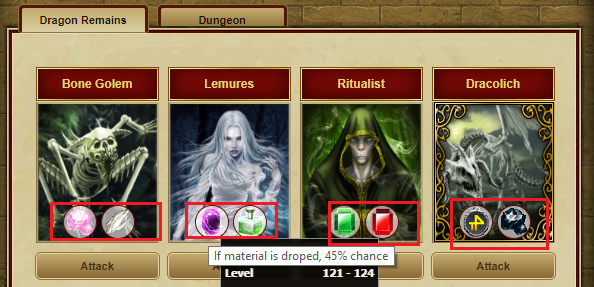
Lemures in Dragon Remains has 45% chance to drop  and 25% chance to drop
  .
.
Smelting
Smelting is the most reliable way to obtain specific forging goods. Depending on the prefixes and suffixes of the item being smelted, exact forging goods can be obtained. See the Smelting page for more details.
Each individual forging good page below lists exactly which prefixes or suffixes to smelt to obtain that material.
Forging Goods Quality
Forging goods come in six quality tiers: White, Green, Blue, Purple, Orange, and Red.
- Use White, Blue, and Purple qualities for repairs and conditioning
- Save Orange and Red qualities for forging high-quality items
Forging Goods Categories
Browse forging goods by category. Each category page provides an overview and links to detailed information about individual materials, including drop locations and smelting sources.
Materials
Basic building blocks and textile materials. Includes Wood, Copper, Leather, Iron, and various cloth materials like Wool, Hemp, Linen, and Silk.
Monster Parts
Materials harvested from defeated creatures. Includes common drops like Fur and Bone Splinter, as well as rare Underworld materials from Cerberus, Hydra, Sphinx, and Typhon.
Gemstones
Precious materials primarily used in healing prefixes and suffixes. From common gems like Amethyst and Garnet to very rare Underworld gemstones like Sugilite.
Flasks
Alchemical liquids including potions, tinctures, and essences. Features important materials like Tincture of Stamina (used in Lucius prefix) and various specialized reagents.
Runes
Magical materials essential for powerful enchantments. Includes common runes like Earth Mark and Storm Rune, as well as rare Underworld runes like Shadow Rune.
Ores
Mineral materials ranging from common ores like Crystal and Bronze to very rare Underworld ores like Almandin, Cuprit, and Hellstone.